
What separates social media programs that produce results from those that don't?
That question keeps the lights on here.
Fifteen years of building brands later, here's our POV on social 👇
By the time a buyer is "researching," the shortlist is mostly written.
So the job isn't driving clicks. The job is building memories (mental association).
We build brands worth remembering — known, trusted, and distinct enough that when a buyer's moment comes, ours is the name already in their head.

Most enterprise programs we meet have the motions down.
Calendar, cadence, a monthly report that goes out on time.
What's missing is a strategy. And we don't mean a deck.
We mean a set of connected decisions:
👉 goals, audience, narrative, the voices you activate, what each channel is for, what the content is about, how you engage, where paid fits, and how it evolves.
The result of a poor strategy is falling victim to the "sea of sameness." After all, 68% of B2B buyers say the vendors they encounter all sound the same.
That's a deal killer, because B2B buyers default to the familiar. As humans, we tend to shortlist brands we already know and trust.
Being memorable isn't a tactic, it's the whole point.
To run a social media program that gets your brand selected, the fix is better decisions (not just better creative).
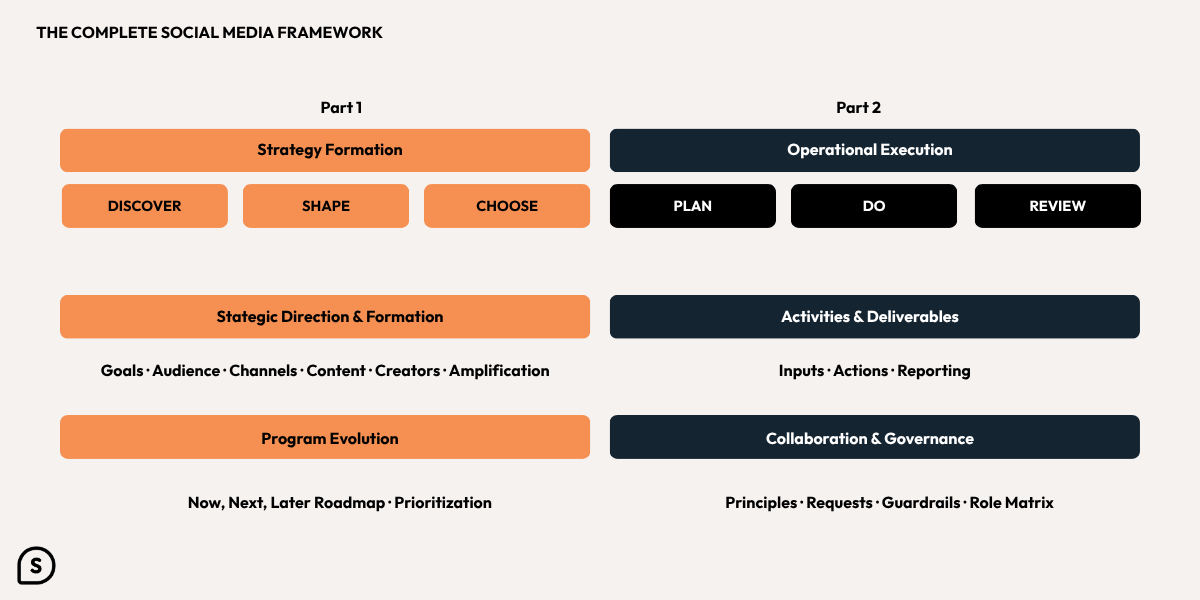
Let’s dive into the customer journey and ask ourselves a difficult question:
What is the cognitive work a brand needs to accomplish in the buyer’s mind before, during, and after a purchase decision?
Instead of overcomplicating the answer, we use the DSC framework:
Discover, shape, choose.
| Discover | Shape | Choose |
|---|---|---|
| Become known to the future buyers who don’t know you yet. If they don’t know your name when they enter a buying cycle, you won’t make the shortlist. | Build the associations that make you the obvious choice. Move from “I’ve heard of them” to “they’re the ones who get this." | Convert the small percentage who are in-market now. Deliver proof, clarity, and confidence. |
Every decision in a well-built social program — goals, audience, channels, content, engagement, paid — maps to one of these three jobs.
When it doesn’t, you’re producing content without a reason.
Some brands do excellent campaign measurement. The ones that don’t, either:
Examples of this include:
Our social media programs (and hopefully, yours too) measure:
They’re different time horizons of the same objective: influencing buyers to choose you.
Naturally, we also have a list of content performance indicators to analyze and understand whether campaigns are leading and lagging.
Both brand and demand goals have their own subset of metrics that help us understand two key aspects:
| Leading | Lagging |
|---|---|
| Profile visitors | Perception shift |
| Views & impressions | Branded search volume |
| Mentions and share of voice | Recall and recognition |
| Engagement rate | Direct / dark traffic |
| Follower growth |
| Leading | Lagging |
|---|---|
| Clicks to key content | Influenced conversions |
| Leads from social | Pipeline influenced |
| Social actions from target accounts | Win rate on social-touched accounts |
Leading indicators are the early warning system — on-social signals the work is gaining traction while there’s still time to adjust.
Lagging indicators confirm the work is translating off-social into real awareness and revenue.
The measurement story connects the two: Leading indicators show momentum building, lagging indicators confirm it’s translating.
Without this narrative, brand-building programs get killed prematurely (not because they aren’t working, but because no one can see that they are).
Good (and great) B2B social understands a few keystone aspects about B2B, including:
Understanding these roles changes how the program shows up.
The practitioners. They care about usability and workflow, and might carry strategic weight.
In product-led growth, users are the entry point: They discover, adopt, champion, and influence purchasing from inside the account.
They’re the audience most responsible for renewals and expansion.
Content that resonates blends high utility with high emotion, teaching them something useful while making them feel seen.
Budget authority and final decision-making power.
They care about outcomes, risk, and strategic fit.
Content that works with this group: Results, ROI, competitive advantage, evidence that the investment is sound.
Within the audience, it’s the people who shape decisions without owning them — analysts, consultants, internal champions, respected peers.
Content that resonates within this group: Thought leadership and category-level insight worth sharing through their own networks.
In organic social, you can’t target. Content reaches whoever the algorithm serves it to.
This means that audience strategy is about:
Different brands navigate different realities.
A single-ICP business can optimize every piece of content for one audience.
A complex business serving multiple industries and buyer types should build organic content around the bigger ideas that connect all audiences and use paid targeting and channel segmentation for precision.
LinkedIn organic for enterprise brands is a channel for Shape and Choose audiences — aka, warm, known audiences — not a Discover channel.
Net-new Discover audiences require different approaches and executions, including:
Programs that only activate the brand account are playing with one voice in a conversation that rewards many.
A mature program draws from six voices:
Brand Corporate account. Authority & consistency. | Employees Organic reach into networks the brand can’t touch. | Executives Personal credibility. Outsized engagement. |
Community Customer stories. UGC. Authenticity at scale. | In-House Creator Dedicated face. Platform-native content. | Partners External credibility. Audience access. |
Most programs collapse everything into “make posts and check metrics.”
A real operating system separates three distinct modes of work so each one gets done well.
We call it the “Plan, do, review” cycle.
| Plan | Do | Review |
|---|---|---|
| Align before anything gets made | Produce content | Measure and learn |
| Content previews | Distribute and amplify | Performance reports |
| Source curation | Engage proactively | Learning sessions |
The core planning deliverable is a forward-looking view of the content that will be shared over a defined period.
It’s the alignment stage.
In our POV, here’s where the social team assembles and curates content from six key sources.
Introducing the content source grid.
| Strategy and series | Trends and moments | Social listening |
|---|---|---|
| Pre-planned evergreen messaging and recurring content concepts tied to pillars. | Cultural moments, industry events. Trending conversations the brand can join. | Ideas triggered by what the audience is saying, asking, or reacting to. |
| Monthly · Planned | Ad hoc · Reactive | Ad hoc · Reactive |
| News | Content marketing | Product |
|---|---|---|
| Announcements, press coverage, PR-driven content from comms and leadership. | Blog posts, reports, webinars — translated into social-native formats. | Feature launches, use cases — made to feel like content! |
| Planned · Reactive | Monthly · Planned | Planned · Reactive |
For every brand, there is a balance to achieve regarding where the content gets sourced, as:
Doing is about producing and distributing content, and also about engaging in conversations the brand didn’t start.
Produce content from the full cast of characters — not just the brand account.
Distribute through four layers:
Engage proactively on owned posts, on category and influencer content, and on target account content.
Engagement is the workstream most often deprioritized, and the one where B2B brands have the most untapped opportunity.
Review includes reporting (what happened) and learning (what it means and what changes).
The output of a learning session isn’t a dashboard, but a set of adjustments that feed back into the next planning cycle.
This is how “Plan, do, review” becomes a loop instead of a line.
Social media programs should get smarter over time.
A social program doesn’t need to launch fully formed.
Trying to activate every channel, format, and workstream simultaneously is the fastest way to produce mediocre results everywhere and strong results nowhere.
The solution to this is the “Now-next-later” roadmap, instrumental for prioritizing and projecting the program over time.
| Now | Next | Later |
|---|---|---|
| The foundation. Full investment and attention. | Planned and understood but deliberately deferred. | Long-term opportunities. |
| Highest-impact activities given current resources | The team knows it’s coming and can prepare | Requires more maturity, resources, or organizational readiness |
| What you do here needs to be working well before anything else gets added | Not competing for resources yet | On the radar, not yet planned in detail |
The roadmap applies to:
It answers the question every stakeholder asks — why aren’t we doing X yet? — with a clear answer:
Because we’re doing Y first, and X comes next.
Prioritization follows three filters:
When a request passes all three, it gets prioritized. When it doesn’t, it gets deferred with a clear explanation.
Strategy reviews on a cadence, not reactively:
In our experience, a good strategy will result in “stay the course” quarterly reports almost every single time.
Early on, we said that most enterprise social programs don’t fail because of bad content, but because of systems breaking down.
This usually manifests in many ways, including:
All of these happen because the system around the content matters more than the content.
Operating principles make tradeoffs explicit.
Speed vs. quality. Brand vs. conversion. Governance clarity.
These are defined per program and referenced when reasonable people disagree about how to handle something.
If the principles don’t help resolve the disagreement, the principles aren’t specific enough.
Every social program requires the same functions.
What changes is who performs them.
The DACI framework makes ownership explicit, and scales from a two-person team to a global organization.
| Driver | Approver | Contributor | Informed |
|---|---|---|---|
| Owns the work, cooridnates people, accountable for output. | Signs off before work is finalized. | Provides input, assets, or support, but doesn't necessarily own the output. | Needs to know what’s happening, but isn't involved in doing it. |
The act of filling in the matrix is where the value lives.
It forces a conversation about who owns what, reveals gaps where nobody is assigned, and surfaces overlaps where too many people think they’re the driver.
Our advice here is to stop treating governance as bureaucracy.
Instead, think of it as the system that makes speed and quality possible simultaneously.
Better Enterprise B2B social media is a strategy problem, an operating system problem, and an organizational design problem.
The companies that win are the ones that treat it that way — building programs with interconnected decisions, clear ownership, honest measurement, and the discipline to get smarter over time.
This is the work we do at Sculpt.

201 E Washington St #1002
Iowa City, IA 52240