

How awful does it feel to start from the right instinct and end up with the wrong solution?
That’s what happens to a lot of teams with brand safety.
Protecting the brand is a good instinct, and it’s an important part of the job for in-house teams and agencies.
It’s also the reason you worry about aspects like adjacency, bad actors, and screenshots going viral. That’s the gist of brand safety on social media.
Here’s an example of how adjacency and bad timing turned out wrong for soda brand Poppi on X:
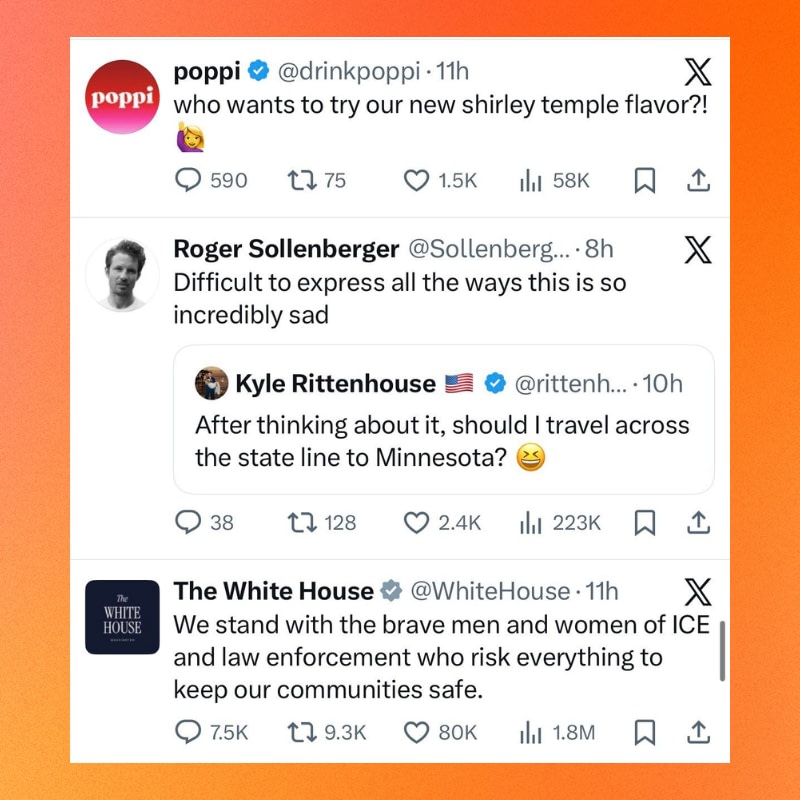
The opposite of unchecked risk is the wrong kind of boredom, and no, you don’t want that either.
The idea is to strike a balance, but for that to happen, you have to look at the brand first.
At Sculpt, we see mismatched brand safety all the time:
- Emerging brands either take all the risks or borrow rules built for companies ten times their size.
- Breakthrough brands are toning down from what made people care in the first place.
- Established brands are buried under processes that protect the logo but paralyze the work
This is the starting point for any brand safety approach: What kind of brand you are, how visible you’ve become, and how much risk you can stomach.
We’ll look at brand safety on social media through the three stages above (emerging, fast-growing, established) and three dimensions:
- What you say (messaging, execution).
- Where you show up (channels and platforms).
- How you work.
The goal: To keep the brand safe, but not in exchange for impact.
Three brand realities: Emerging, fast-growing, established
Brand safety approaches start by placing the brand into one of these categories.
So, which one are you?
Emerging brands: Trying to get noticed at all
New startups, new business units, and fresh rebrands: These are the usual early-stage players.
Awareness is low to zero. The upside of getting noticed is huge. The downside of a misstep is small.
For brands in this category, the risk is remaining unnoticed.
What we see in these brands’ strategies is two patterns:
- Chaos: Founders and social media managers posting fast, taking swings, no shared sense of “we’re going too far with this one”.
- Misalignment: Someone imports a strategy that doesn’t fit a brand that’s barely launched.
Both are brand safety problems. So, what should safety mean for emerging brands, then?
In our view:
- A short list of no-go zones.
- Enough freedom to experiment with voice, topics, and platforms before the brand hardens.
Examples of emerging brands that take big risks and collect wins are somewhat common, particularly in certain industries like tech, finance, and crypto.
Fast-growing brands: Suddenly under the microscope
Fast-growing (or breakthrough) brands are in the “people are finally paying attention” phase:
- They’re getting invited into deals, events, and podcasts - and they’re also new in their vertical.
- The reality switches from “no one knows us” to “we could actually mess something up.”
And that’s when overcorrection happens.
So, what does safety mean for fast-growing brands, then? In our view:
- Drawing a line between brand safety (what’s never okay) and brand suitability (what’s right for this brand to say).
- Building guardrails that encourage momentum and thinking through risk rather than “freezing”.
Established brands: Trust, scrutiny, and complexity
Established brands are known and trusted at scale.
They operate in regulated environments and public markets.
For them, a social misstep goes beyond drama; it can affect sales, reputation, recruitment, and even stock price.
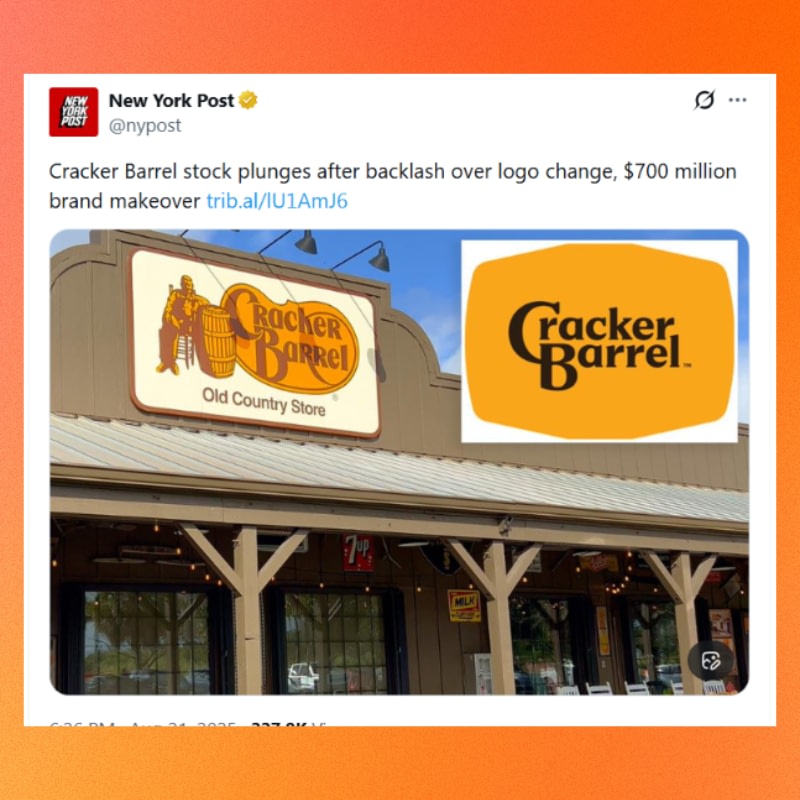
Here, “protect the brand” is shorthand for:
- Protect our license to operate.
- Protect customer and employee trust.
- Protect the company in front of investors, regulators, and media.
Add overlapping policies, regional variations, legacy workflows, and the trauma of past crises, and you have the perfect storm to work with.
When it looks bad, you’ll see:
- Everyday posts getting press release treatment.
- Social teams buried in approvals and red tape.
- Inconsistency across markets and teams.
So, what safety should mean for established brands then? In our view, it’s about:
- Systems that help people make better, faster decisions about risk.
- Clear lines over when to be cautious, when to speak up, and when to sit a moment out.
There’s nothing wrong with taking a moment to check where the brand stands.
In fact, it’s a necessary moment of reflection for what comes next:
- What you say.
- Where you show up.
- How you work.
Three dimensions of brand safety (applied differently by stage)
Once you know what kind of brand you’re running, the next question is simpler:
Where does brand safety actually manifest in day-to-day operations?
It’s usually one of the three dimensions:
- What you say (messaging, topics, tone, claims).
- Where you show up (channels, formats, placements, partners).
- How you work (workflows, approvals, access, automation).
Below, we’ll walk through each dimension through the lens of emerging, fast-growing, and established brands.
1. What you say (messaging and execution)
This is the public-facing layer: Posts, threads, videos, replies, and statements that carry your logo.
For emerging brands, “what you say” should be where you take the most intelligent risks.
You can afford to test stronger POVs and talk about problems with more honesty than incumbents.
Brand safety here is about:
- A short list of hard no’s (hate, discrimination, slurs, etc.).
- Avoiding claims you can’t back up yet (results, guarantees).
- Being clear when something is an opinion, not a promise.
For fast-growing brands the “What you say” is about adding a credibility filter. New questions appear:
- “Do we actually have the right to talk about this topic?”
- “Is this aligned with what our CEO says on stage or to investors?”
- “Could this quote live in a critic’s screenshot and still make sense?”
Here’s where teams discover the difference between brand safety (no discriminatory, hateful content) and brand suitability (we plant our flag in topics that we care about, even if some people don’t like it).
The (ideal) outcome: You keep your edge, but you stop baiting and calling for unwanted attention.
For established brands, what you say is evaluated against a much larger context:
- Past statements.
- Regulatory expectations and internal policies.
- Employer brand and DEI commitments.
The challenge is to be consistent with the above, but without sanitizing everything so that no one listens.
2. Where you show up (channels, platforms, and placements)
As it turns out, brand safety is also about where the brand develops a presence.
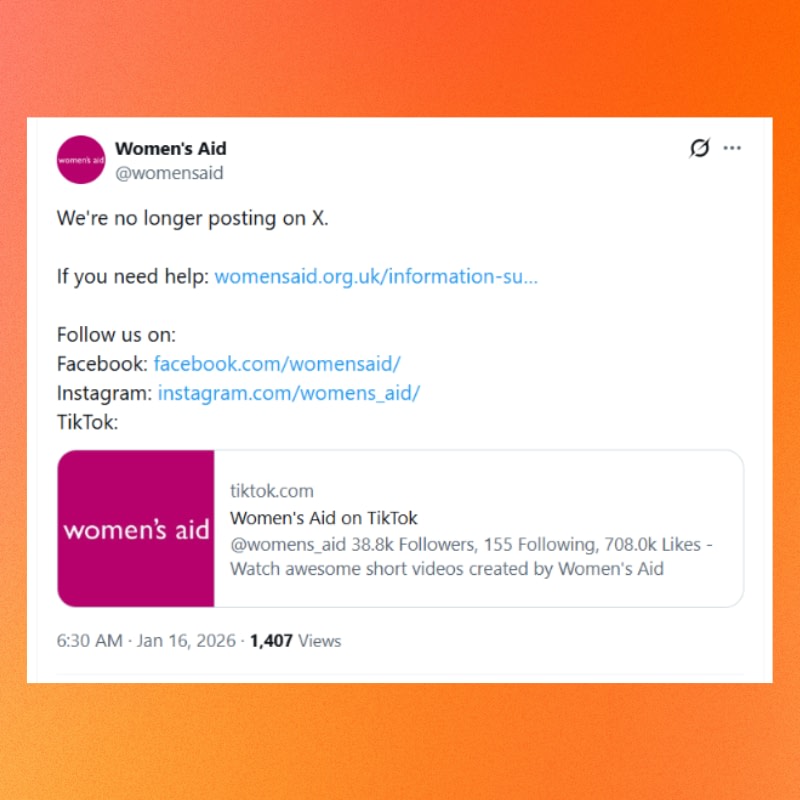
Emerging brands can and should use social media to punch above their weight.
That means testing platforms with higher “volatility” (X, Reddit, TikTok), where organic wins are still possible.
The safety layer here is simple: Pick spaces where you understand the norms, and where you can respond in real time.
Fast-growing brands will usually have their core channels defined by now.
Channel-wise, they start paying attention to ad adjacency (topic filters) and partnership types. Aka, more “context-aware”, but hopping on trends regularly.
For established brands, “where you show up” is often as important as what you say.
Brand safety here typically means:
- Excluding content categories (violence, political content).
- Considering geography and timing.
- Setting rules off-limits publishers, regardless of reach.
3. How you work (workflows, approvals, and access)
This is the part of brand safety nobody wants to talk about, but ignoring it doesn’t really get us anywhere.
In terms of pace, emerging brands should strive for:
- Clear ownership: who can hit “publish” and on which accounts.
- Everyday content: one person drafts, one person sanity checks.
- Sensitive content: pull in the founder, but keep the group small.
Brand safety at this stage is less about formal SOPs and more about avoiding “I thought someone else checked that” moments.
For fast-growing brands, pace is about splitting work into fast lanes and slow lanes.
- Fast lane: Everyday posts, recurring series, low-risk topics.
- Slow lane: Sensitive topics, leadership visibility, riskier experiments.
For each lane, define who drafts, who reviews, and who approves, and when to involve legal/HR.
Brand safety here is about creating friction where it belongs.
For established brands, pace is about too much process, scattered across teams and regions.
A healthy setup usually includes:
- Risk-tiered workflows.
- Training for social teams and approvers on how to apply the rules.
- Templates, examples, and docs that live where people work.
Inside the work: How we design brand safety with clients
To wrap this short guide, I’m sharing the simplified version of how we approach brand safety at Sculpt.
The real thing has more steps/docs (and alignment meetings), but the spine looks like this.
1. Map the brand reality
First, we get clear on where the brand actually is. We look at:
- Stage: Emerging, fast-growing, or established.
- Category risk: Regulated vs not, industry, ecosystem.
- History: Past social wins, scares, or crises.
- Culture: How decisions are really made, how “protect the brand” is used internally.
This is where we check whether the playbook matches the reality.
2. Define risk appetite
Next, we turn “be safe” into something specific. We align on:
- Non-negotiables: What’s never okay, regardless of performance.
- High-risk but worth it: Where the brand is willing to take risk and heat.
- Low-risk and over-controlled: Where processes can be loosened.
For this to work, leadership has to be in the room.
3. Guardrail work
We translate the risk assessment work into rules across the three dimensions (what you say, where you say it, the process we use to keep posting on socials).
Here we define things like:
- Examples of on-brand vs off-brand posts.
- Core channels vs experimental channels.
- Ad adjacency settings.
- Fast lane vs slow lane content.
- Who drafts, who reviews, who approves (by lane).
4. A note on culture and SOPs
You can have the cleanest framework in the world and still go nowhere if the internal culture doesn’t support it.
If every visible risk is punished, teams will default to safety and forget the framework.
If nobody is willing to remove old rules that no longer fit the brand’s stage, the system just keeps getting heavier.
So part of the work is naming the gap:
“Given your current culture and SOPs, here’s the level of brand safety you can realistically run”
Interested in the extended version of our brand safety approach? Let’s get in touch and talk about it.