

Raise your hand if you’ve been told that the secret to a successful exec social media presence requires you to “post consistently”, and that this will lead—nearly by default—to loads of credibility and authority.
We’ve heard it too. And we think it’s only half true...at best.
Let’s clear the fog: Consistency helps. Showing up too.
But those aren’t the reasons that make or break an exec’s social media presence. If anything, they’re the easy part.
Why executive social programs fail
We’ve run enough exec social media programs to know the three reasons why they run out of steam.
1. Time
If the people supporting an exec can’t actually get time with them (e.g. no quick conversations, no approvals, no “pick your brain” sessions), everything grinds to a halt.
Good posts don’t come from templates and formulas. They need executive input (and it’s always better this way).
2. Commitment
Even with time, exec social only works if the exec cares.
When it’s low on the priority list, content slips, cadence breaks, and the program dies quietly.
3. Perfectionism
Some execs won’t share unless a post hits an unrealistic bar.
More often than not, this leads to a mix of over-polished content that feels corporate in a bad way (aka stiff, staged), or to long silences waiting for “perfection” to arrive.
These are the main reasons, but there’s another big blocker that influences every program before it even starts.
The missing ingredient: Resources
Execs posting 19 times a day on average across three different platforms are total outliers, and trying to mimic this level of intensity is unsustainable.
In the majority of cases, resources need to be compounded, or otherwise the program sinks.
Simply put, plenty of execs want to post more, but there’s no one there to help them.
To address this bottleneck, some companies incorporate roles like Executive Communications Managers, but there’s no shortage of execs relying on already-busy marketing teams to do their bidding (or no one at all).
And to deal with this, we came up with frameworks that work no matter who’s in the driver’s seat, as they are:
- Sustainable (fitting a busy exec’s reality).
- Predictable (so content doesn’t stall every other week).
- Easy to replicate (if someone new steps in tomorrow, nothing breaks).
Worth telling, these are not one-size-fits-all solutions; each of them addresses specific pain points, such as brand safety, content approvals, or coming up with ideas for posts.
For safety checks: The green–yellow–red framework
The first challenge is figuring out what’s safe to post.
That’s where many programs get jammed up: Hours are wasted debating whether an idea is harmless, risky, or a total snoozefest.
We’ve found a simple filter that clears the fog: The traffic light.
Green Zone posts are the easy wins:
- Company culture.
- Leadership philosophy.
- Philanthropy.
- Article recommendations.
They humanize without raising any eyebrows. If it’s green, you don’t need to ask permission. Just go ahead and post!
Yellow Zone posts are the middle ground:
- Customer shoutouts.
- Sharing numbers.
- Lightly contrarian takes.
These are interesting and valuable, but also need a quick review. Think of it as sending a text to comms and waiting a day.
If you’re in a regulated industry (like pharma), the legal department might need to check them from time to time.
Red Zone posts are the “don’t even start writing” bucket, and include:
- Sensitive company moves.
- Non-public financials.
- Airing personal grievances.
Nothing good comes out of them, but once you ID them mentally it’ll be easier to let them fade on the spot.
For faster approvals: Rethinking the approval process
Review cycles can kill momentum if they’re inefficient and 100% people-dependent.
The guardrail here is speed. We run everything in two lanes:
Green posts? Execs publish on their own.
Yellow posts? We either:
- Drop them into a shared channel for a quick 24-hour check.
- Create an automated form that reaches the right stakeholder depending on what you check in there.
Who looks at them depends on the post. Comms for tone. Brand for alignment. Product marketing if there’s data or customer names.
The point is light-touch. A single round of eyes, not a marathon edit.
For content ideas: The ingredient pantry
Even with approvals sorted, the big question remains: What to post?
Execs already juggle full calendars, and it’s hard to pin them for brainstorming content ideas.
This is why a content ingredient pantry (stocked, simple, always ready) makes total sense.
Some go-to ingredients are:
- A lesson learned the hard way.
- A quick reaction to an industry headline.
- A photo from an event with one personal takeaway.
- A short shoutout to a teammate or partner.
- A stat or report you disagree with (and why).
Furthermore, we recommend setting up an AI sparring partner and training it to provide you with prompts that sound like you.
To improve delivery: Writing rules that keep you credible
We don’t need a writing course here. A few principles that stick are way more productive - and here’s what works:
- Share opinions, not instructions. “I believe” beats “You should”.
- Skip absolutes. “Always” and “never” invite trouble.
- Numbers need context. Otherwise they look cherry-picked.
Three things to avoid altogether: Financial predictions, security details, and clinical claims.
That’s it. Simple enough to remember, strong enough to keep posts from backfiring.
To build community: A comment game plan
Our rules here are simple:
- Respond within 24 hours of a post.
- Log notable replies (saves, screenshots) to inform future posts (shares) + ads.
Some execs (notably Palmer Luckey of Anduril) build their entire LinkedIn strategy around comments!
To ramp up visibility: Paid campaigns
Relying on organic content alone to improve your visibility (particularly on LinkedIn, where exec content thrives) is like showing up to a gunfight with a knife.
In other words, we highly recommend running a few paid campaigns in parallel to posting organically.
Furthermore, there’s a type of LinkedIn campaign that fits exec content strategies like a glove: LinkedIn Thought Leader Ads.
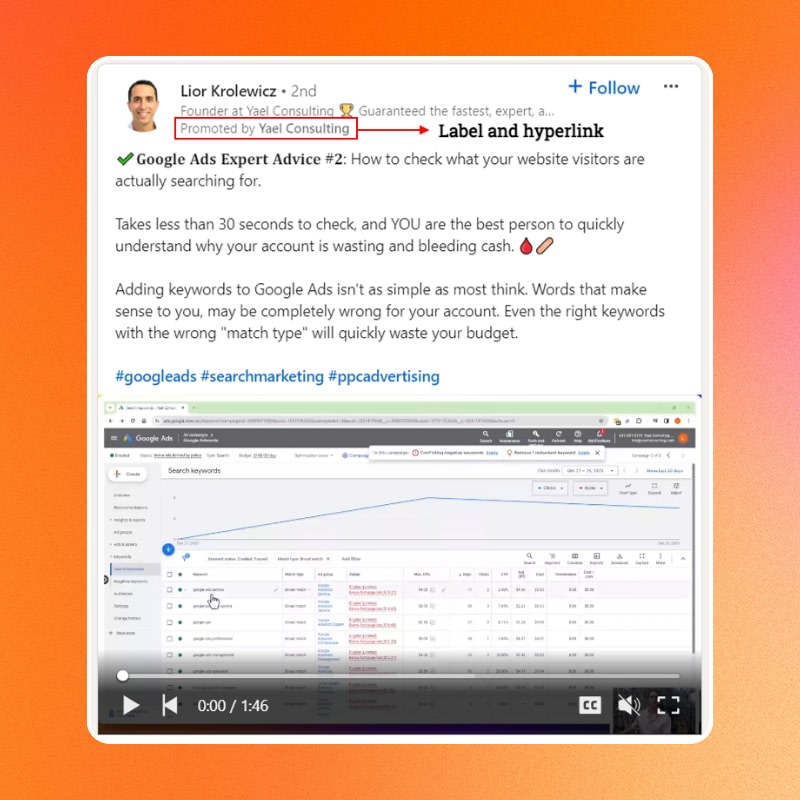
Since they integrate seamlessly into the feed, TL Ads are the best format to get more eyes on your content and (help) build thought leadership in your vertical.
Key in-ad metrics include follows and profile clicks, useful to track interest and influence levels.
For more advanced tracking, consider tagging every promoted post with UTMs; GA4 can’t reliably split organic vs. paid on the same post without them.
To avoid a crisis: A quick backup plan
If there’s a crisis, the first step is knowing who has the power to hit pause.
So, there should be one clear owner.
Then, be ready to acknowledge carefully. Empathy works and buys time, speculation doesn’t.
And remember: The only thing worse than silence is an impulsive post that makes things worse.
To measure success: The metrics
Let’s say it out loud: Likes, shares, comments, and impressions aren’t vanity metrics, and there’s nothing wrong about chasing them.
Aside from engagement and reach, we also recommend tracking follower growth, and having at least one custom goal (such as number of relevant DMs or connections that your posts produce).
Finally, make sure that the reports you’re getting are easy to understand: 99% of the time, a light assessment is the real MVP.
Getting real: A 30-day cadence to try out
If all of this feels too abstract, here’s a simple rhythm we use to get execs moving:
- Week 1: a story from your own leadership experience.
- Week 2: a reflection on your team or a recent event.
- Week 3: a take on industry research or a headline.
- Week 4: a customer or partner lesson (with their blessing).
This is not an exec program yet, but an ignition phase. Just enough to build the habit without feeling like a second job.
Profile basics
If you haven’t updated your profile in a while, here’s a quick way to bring it to life:
- Pin a featured post.
- Tighten the headline.
- Keep a recent headshot.
It lifts post performance with zero extra writing!
Who to follow for inspiration?
Our rule-of-thumb is to follow people in your industry or vertical, as their content already resonates with audiences that overlap with yours.
However, there are multiple execs who excel at social media, and they’re worth following (and connecting with) for the quality of their content alone.
We’re not going to overwhelm you with recommendations here, so we picked four that will inspire you in different ways:
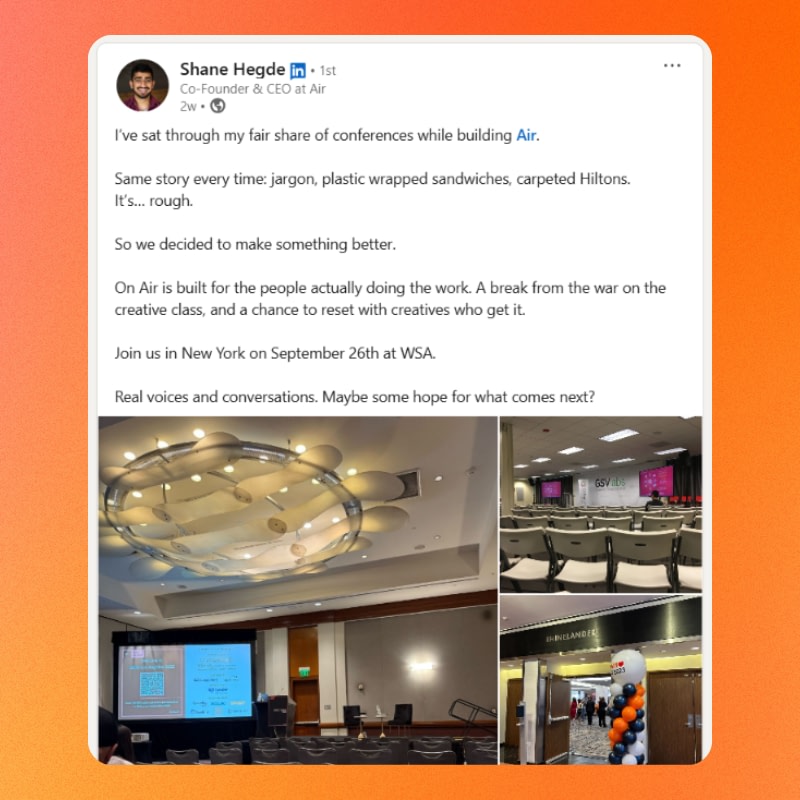
- Shane Hegde, CEO of Air. Great content variety, leverages different formats, nails a relaxed/approachable tone every single time.
- Matthew Derella, VP of LinkedIn Marketing Solutions. If you want to learn how to share LinkedIn content, Matthew is the person to follow. Not everything lands, but he’s always experimenting.

- Ali Ghodsi, CEO of Databricks. Product, people, and numbers with academic precision and incredible timing (and his leadership team follows the same playbook with similar results).
- Anton Osika, Co-founcer of Lovable. Perhaps the most modern approach to posting on Linkedin (within these recs). Worth taking a look if authenticity what you’re craving.
Conclusion
When exec social media programs collapse because of lack of time, lack of commitment, or excessive perfectionism, frameworks become the structures that make social doable.
Whether the exec is flying solo, backed by a comms partner, or working with an agency, these guardrails make it possible for leaders to sound like themselves, and actually click.
So stop waiting for the perfect formula, and get posting. And if you can’t spare the time, drop us a line - we’re always up for a real challenge!