

How many LinkedIn employee advocacy programs follow the same arc?
A strong launch, accompanied by a few weeks of momentum — and then, the same five people posting, while everyone else opts out.
While online conversations rush to recommend tools, this is not a tool problem.
The problem is that most advocacy programs equate employees to distribution channels with a LinkedIn account.
Most employee advocacy advice focuses on the program: Platform, content queue, guidelines, and rolling it out.
This piece starts one step earlier: What would make employees want to advocate for the company on LinkedIn at all?
For the detailed mechanics of building an employee advocacy program, we cover that in a dedicated guide.
LinkedIn employee advocacy works when there is a clear exchange.
The company gets reach, trust, and market presence. The employee gets visibility, credibility, access, and career upside.
When only one side benefits, the program usually dies.
So the strategic question is not “How do we get employees to share more?”
It is “What can the company provide that makes posting worth the employee’s name, time, and reputation?”
The problem: Employees don't see what's in it for them
An uncomfortable truth is better than a comfortable lie, so here’s one:
Nobody wakes up excited to share their company's latest blog post.
The employees who are on LinkedIn — particularly those who are active on the platform — have spent years building their network there.
Imagine their thoughts when a program asks them to put their name on content they didn't create or approve.
To put it kindly, they quickly understand that it’s their credibility on the line, not the brand's.
And what drives their behavior is not loyalty to the company, but their own personal gain, which on LinkedIn translates to:
- Connections.
- Inbound opportunities.
- Industry visibility.
- Career options.
- Let's illustrate this with a real-life, recent example.
In May 2026, Coinbase’s CEO Brian Armstrong announced layoffs on X.
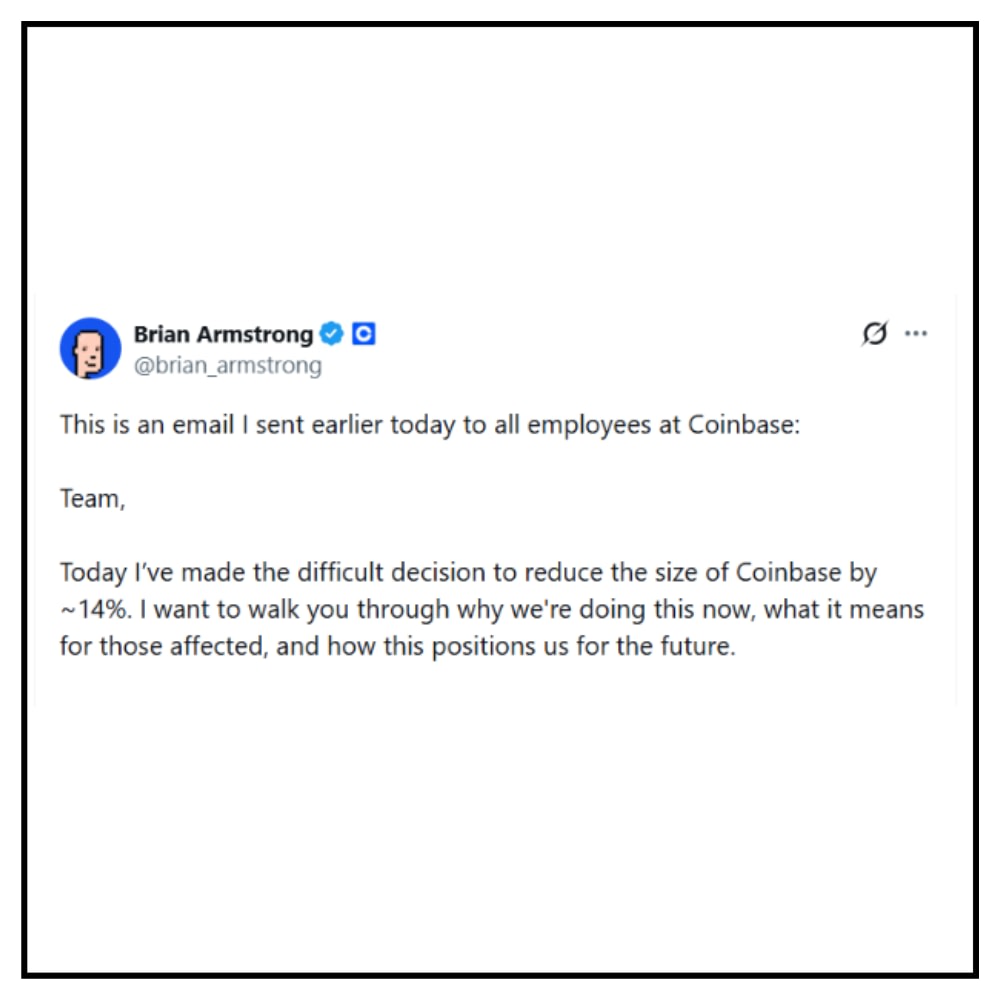
Within hours, affected employees were already posting on social media, showcasing the projects they tackled at Coinbase, and signaling their availability.
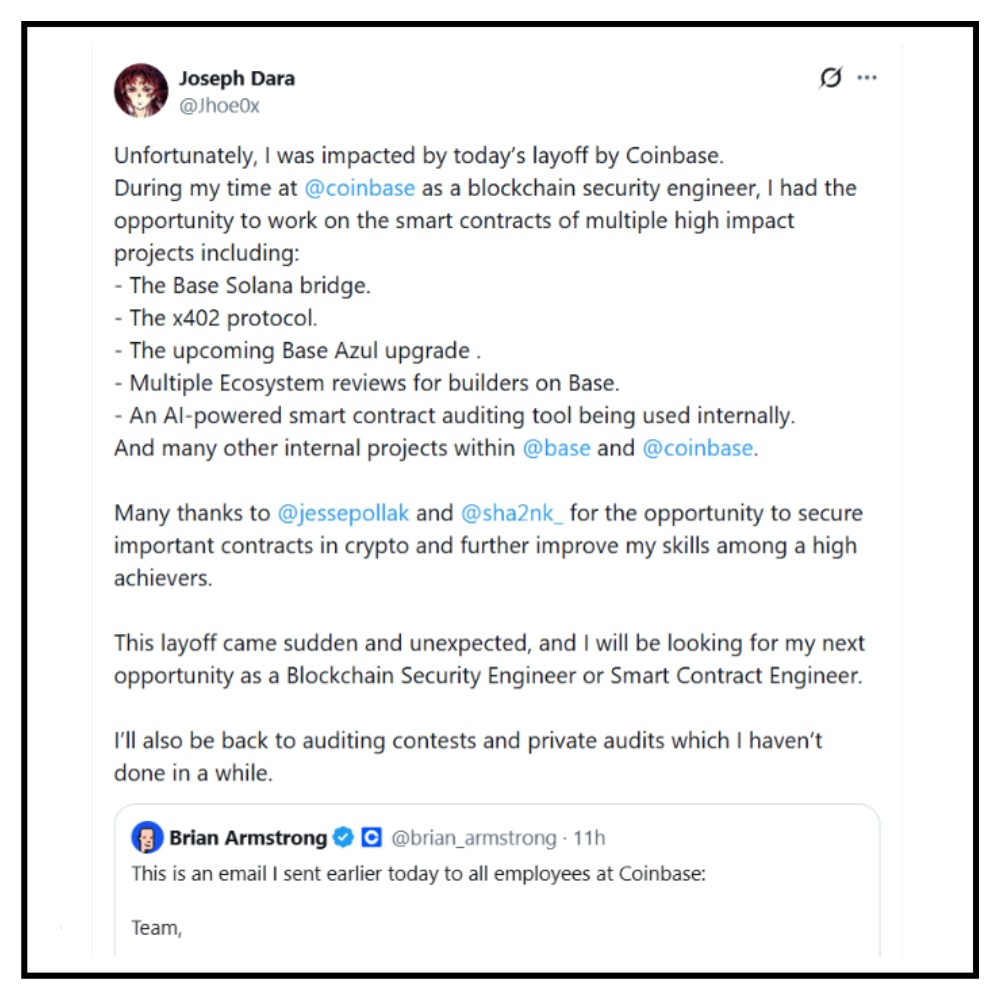
And why were we seeing these posts emerge?
Most likely, because there was a clear context and incentives to make this kind of post right then and there:
- The news of the layoff went viral (attention spike).
- The benefit of posting was clear (more people paid attention to first-hand accounts of the event).
The challenge is to replicate that level of clarity (ideally, without waiting for a layoff crisis to see it in action).
What motivates employees to post?
Spoiler: It's not the leaderboard, the swag, or the gift card for the top sharer.
In addition, there are a few motivators that employees can pursue on their own, without an employee advocacy program in place, including:
Connections and inbound opportunities
94% of employee advocates say posting on LinkedIn has directly benefited their careers through inbound job offers, consulting requests, speaking invitations, and intros that wouldn't have happened otherwise.
Industry visibility
Being seen as someone worth following is how many careers get built nowadays.
Getting popular on LinkedIn is also a path towards speaking slots, bylines, podcast invitations, and other career-building opportunities.
Since employees don't need a program to get any of this, the real question is:
What motivates employees to participate in an employee advocacy program?
In our view, the answer requires the company to bring something real to the table.
That “something” can take different shapes, such as:
- Content and editorial support: Helping employees who have expertise but struggle to articulate it.
- Access: To company data, research, resources, and stories they couldn't tell without the program’s backing.
- Recognition: Public, specific acknowledgment from leadership that carries weight beyond company walls.
- Compensation: Some programs tie advocacy participation to bonuses, performance reviews, or equity.
- Perks: Conference and event access, coaching, and profile development. Things that compound the employee's career regardless of where they end up.
The programs that sustain participation make this exchange explicit.
That exchange should shape the strategy before a tool, content queue, or rollout plan enters the conversation.
A useful LinkedIn advocacy strategy answers five questions:
- Who has a real reason to post?
- What do they want to be known for?
- What can the company give them that they could not create alone?
- What kinds of posts help both the employee and the company?
- How will we know whether the employee is benefiting too?
If those questions are unanswered, the program defaults to the easiest available behavior: Asking people to repost company content.
Who should the employee advocacy program start with?
A common mistake is launching company-wide with the all-hands email, the big internal announcement, that whole “everyone's invited” switch getting turned on.
That’s likely to result in a lukewarm response from most, a burst of activity from a few, and a slow fade back to silence.
Instead, start here
Customer-facing roles are the obvious first wave:
- Sales
- Customer success
- Solutions engineering
They're already having the conversations the program wants to amplify, they understand the audience…and some of them are probably active on LinkedIn already.
Program-wise, this means they've crossed the activation threshold. They need support, not convincing!
And whoever goes first sets the tone — when a respected colleague starts posting and visibly benefits, others take notice.
Choose early advocates carefully! A good first wave is not just “people who will say yes.”
Look for employees with three things:
- They are close to useful stories. They hear customer problems, objections, product questions, implementation lessons, or market shifts before the rest of the company does.
- They have something to gain. Their career benefits from being known by buyers, peers, partners, candidates, or industry operators.
- They can post with enough judgment. They do not need to be polished creators, but they do need to understand what should stay internal, what can be discussed publicly, and where the company needs to review.
That combination matters more than other signals (like department, seniority, or raw enthusiasm).
Who can wait
Volunteers aside, everyone else.
Pulling in reluctant participants too early produces low-quality content and sends an ambiguous signal. Let the results from the first wave do the convincing.
Start small, make it work for the people who opted in, and let that become the reason others want in.
What about leadership?
Executives posting on LinkedIn operate under different constraints: Often, more sensitive messaging, more complex approval dynamics (hello, legal).
The principles are the same, but the execution deserves its own treatment, and we'll cover it separately.
Build the strategy around usable raw material
Once you know who should participate, the next question is:
“What can we give them that helps them say something worth sharing?”
Most companies already have the raw material for strong employee advocacy: It lives in sales calls, customer onboarding notes, support tickets, implementation stories, product decisions, research, internal debates, event conversations, and also in the weird little observations people collect while doing the work.
The advocacy program’s job is to turn that raw material into posts employees can credibly stand behind.
That usually means creating a few content lanes:
- Customer problems the employee helped solve.
- Market patterns they keep noticing.
- Lessons from implementation, onboarding, sales, support, or product work.
- A clear point of view on a category conversation.
- Behind-the-scenes context that makes the company’s work more legible.
This is where the company becomes useful. Instead of thinking about pre-written content, consider giving employees access, structure, editing, and permission to speak from their actual work.
What good employee advocacy looks like
You already know the difference. You've scrolled past both. One gets something from you (a reaction, a comment, or maybe just a personal reflection).
The other makes you cringe hard.
Without getting into program specifics that may or may not apply, here's what to watch out for, and what to aim for.
What to avoid
You've seen this post a hundred times:
Leads with the company name.
Announces something the employee had no part in.
Polished, impersonal language with no opinion or specific detail (“I’m proud to announce that…”).
Comments are colleagues saying "congrats!".
Minimal reach — and radio silence from that employee for weeks.

What to aim for
The post starts somewhere real. A few examples of what that looks like in practice:
- A solutions engineer writes about a specific customer problem they spent two weeks solving — the problem itself is interesting. The company comes up naturally.
- A customer success manager shares something they keep hearing across calls and offers their take on it.
- A product marketer pushes back publicly on a common claim in their industry, citing what they've actually seen in their own work.
In each case, the company is present as context (not as the point).
The employee is the point: It's their expertise, observations, and voice.
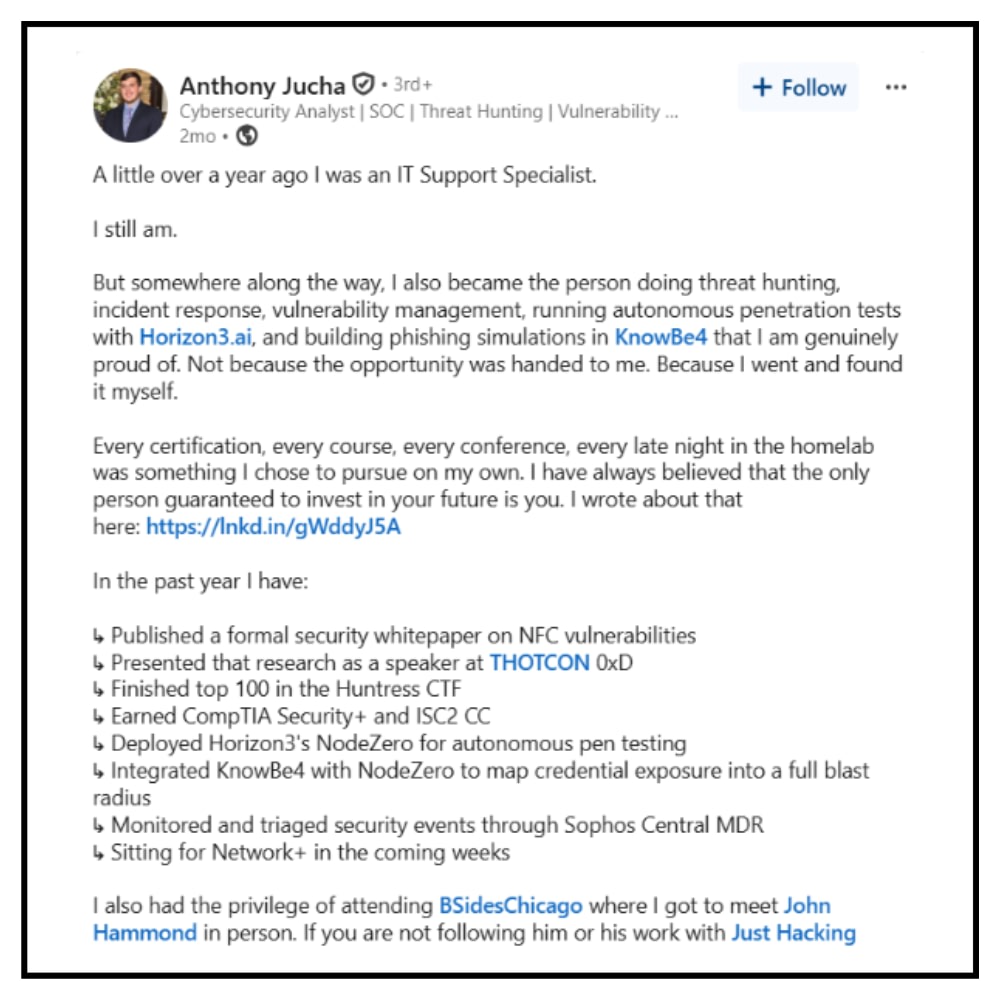
The goal of a well-designed program is to create the conditions where this happens consistently.
A note before you start your LinkedIn employee advocacy program
“How do we get employees to share?” is a logistics question.
The better question comes first:
“Why would employees want to participate at all?”
Once that answer is clear, the rest of the program has something to stand on. You can decide who should participate, what kind of content they should share, how much support they need, what guardrails belong in place, and how success should be measured.
Without the motivation layer, employee advocacy becomes another internal campaign people politely ignore.
With it, the program has a reason to exist beyond borrowed reach.
That is the foundation. The next step is turning it into a working system.
We cover that in our guide to building an employee advocacy program.
LinkedIn employee advocacy is when employees share content, perspectives, or experiences on LinkedIn in a way that builds visibility for both themselves and the company they work for.
It can be organic — employees posting on their own — or structured through a formal program.
A structured initiative where a company actively encourages and supports employees to post on LinkedIn.
At its best, it provides content support, training, and clear incentives.
At its worst, it's a content queue and a leaderboard.
Personal branding is entirely employee-driven — building a professional identity for their own benefit.
Employee advocacy involves the company as a stakeholder. The best programs blur the line intentionally: Employees build their personal brand, and the company benefits as a result.
Fewer than you think, especially at the start. Ten engaged advocates outperform a hundred reluctant ones.
Start with the people who already have a reason to be on LinkedIn, and let the program grow from there.
Most programs track reach, impressions, and shares — which is good, but only half the work (as these are brand-side metrics).
A more complete picture includes:
- Participation sustainability (are the same people still active at month six?)
- Network growth per advocate
- Inbound opportunities generated.
If only the brand is benefiting, the program won't last.