

You know the feeling. The post is ready. The copy is tight, the creative landed, the timing is right. And then, nothing.
It sits in someone's inbox for three days. Or it comes back with conflicting edits that shatter the most optimistic deadlines on the spot.
By the time it goes live, the moment it was built for has passed. Oh, the horror!
This is the “classic” case, but slow approvals take on many different faces. In the wild, we’ve also encountered:
- The approver who disappears for a week and resurfaces with notes the day after the post went live.
- The revision that undoes the previous revision because two stakeholders reviewed in isolation and reached opposite conclusions.
- The last-minute "can we add a legal disclaimer?" that arrives at 4 pm on a Friday with a Monday publish date.
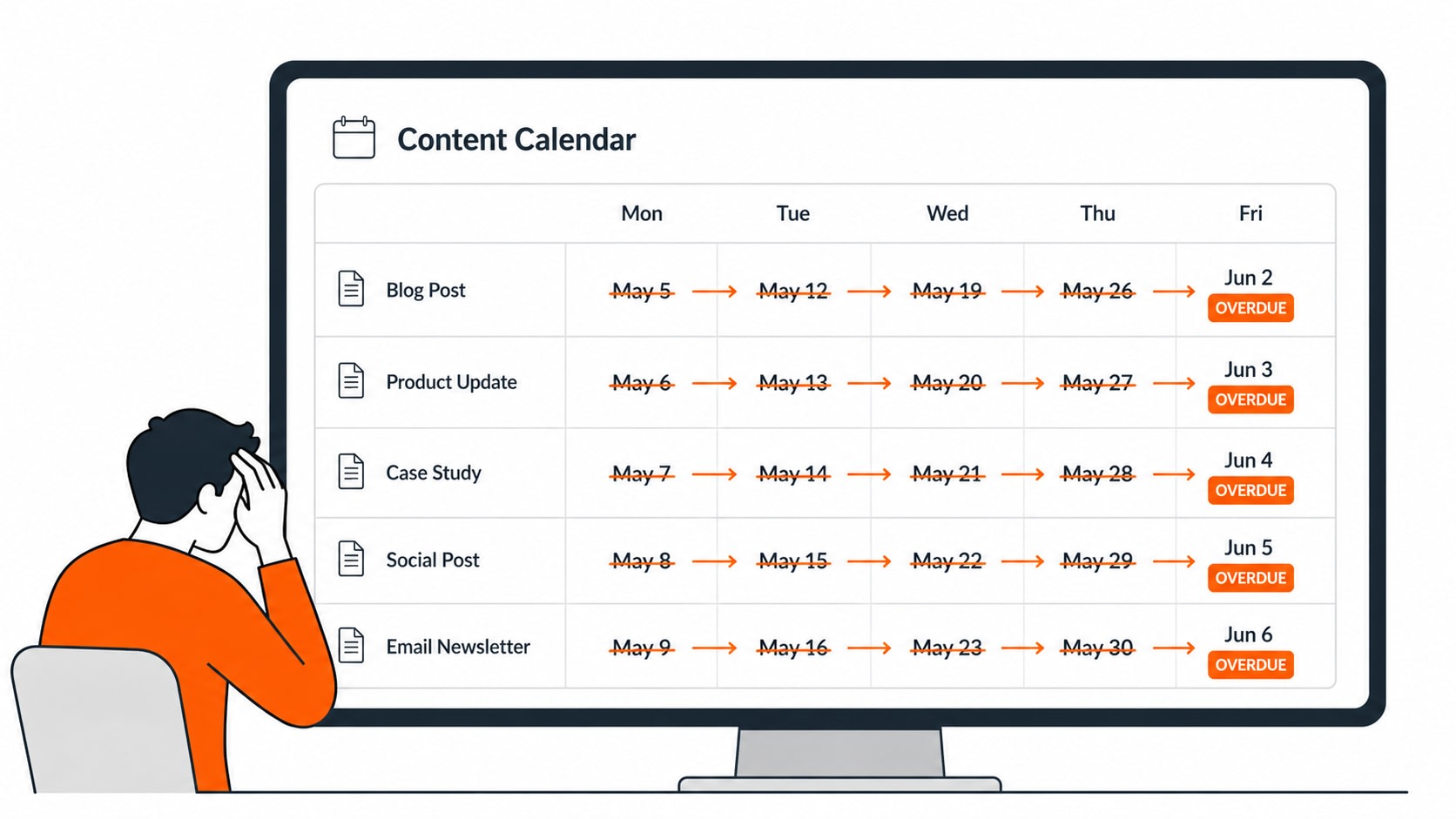
And there's the slow, grinding version: A content calendar that is always running two weeks behind, and a social presence that feels stale.
A lot of people will tell you this is a tooling problem.
Get your client on Planable! Set up approval flows in Sprout! Automate the reminders!
And yes, tools help. We'll come back to that.
But if the organizational issues underneath the workflow are unresolved, the tool may just as well amplify dysfunctionality.
The problem of content approvals goes deeper and tends to cost more than a yearly subscription for your team.
The cost of delayed approvals in social media marketing
The first visible cost is relevance decay.
Social content has a shelf life that's measured in hours rather than days.
A post built around a trending conversation, a news moment, or a product milestone loses value the longer it sits waiting for sign-off.
And it’s good to keep in mind that, if the feed moves on, you still have to pay for the strategy, the copywriting, and the creative.
Finally, there's the morale cost.
Creative teams that watch good work age in an approval queue — repeatedly, over months — sooner or later stop caring (this manifests in behaviors like self-editing toward safe, boring content).
Reasons behind slow approvals
Most approval bottlenecks come from a handful of organizational patterns that we’ve learned to recognize. The main ones are:
1. Nobody actually owns social
If nobody has the authority to decide without consensus, the process slows to the pace of the least available person. This is an ownership problem. The approval chain is long because responsibility was never clearly assigned in the first place.
2. The brand voice isn't resolved
Reviewers add friction when they don't fully trust what they're reading. A slow approval process can sometimes be a form of delayed brand-strategy conversation.
3. Leadership hasn't committed to social
When senior stakeholders treat social as a low-priority channel, that attitude filters down. The implicit message from above is that this doesn't really matter that much. Until social has a genuine internal champion, the process will reflect that ambivalence.
4. Fear dressed up as diligence
Signing off on content means being accountable if it underperforms. For stakeholders who don't live inside social media day to day, that's a real risk with unclear upside. So they stall, they hedge, they ask for revisions that make the content “safer”.
How to fix slow approvals (and where solutions fall short)
The conventional advice is solid as far as it goes:
- Name a single approver with real authority.
- Pre-approve content guidelines so the decision surface is smaller.
- Tier your review process so not everything requires the same level of scrutiny.
- Set an SLA that has teeth.
All of that is right, but there are also constraints to be aware of.
If the named approver is stretched out, the bottleneck will still stand, regardless of the title.
A single point of accountability only works if that person has the time and organizational authority to actually move quickly.
Pre-approved guidelines reduce friction — but only if everyone is aligned on what they say.
Guidelines that were written eighteen months ago and haven't been tested against real content decisions tend to get relitigated.
Tiered review helps, but tiering requires someone to make judgment calls about what constitutes "high-stakes" content versus routine.
In organizations where everything feels high-stakes, nothing gets fast-tracked.
Finally, SLAs only have teeth if there are real consequences for missing them.
The point of implementing these fixes is that they're process solutions to what are often cultural problems.
They work best when the underlying issues (ownership, voice, leadership commitment) have been addressed first.
What we've seen from the agency side
The clients with the fastest, most functional approval processes share a few things in common.
First of all, they have a single named point of contact who has the authority and availability to move quickly.
They've done the brand voice work upfront, and they treat timely approval as part of their own content strategy.
On the other hand, the clients with the slowest approval processes almost always lack a genuine internal champion.
So, how does an agency fit in?
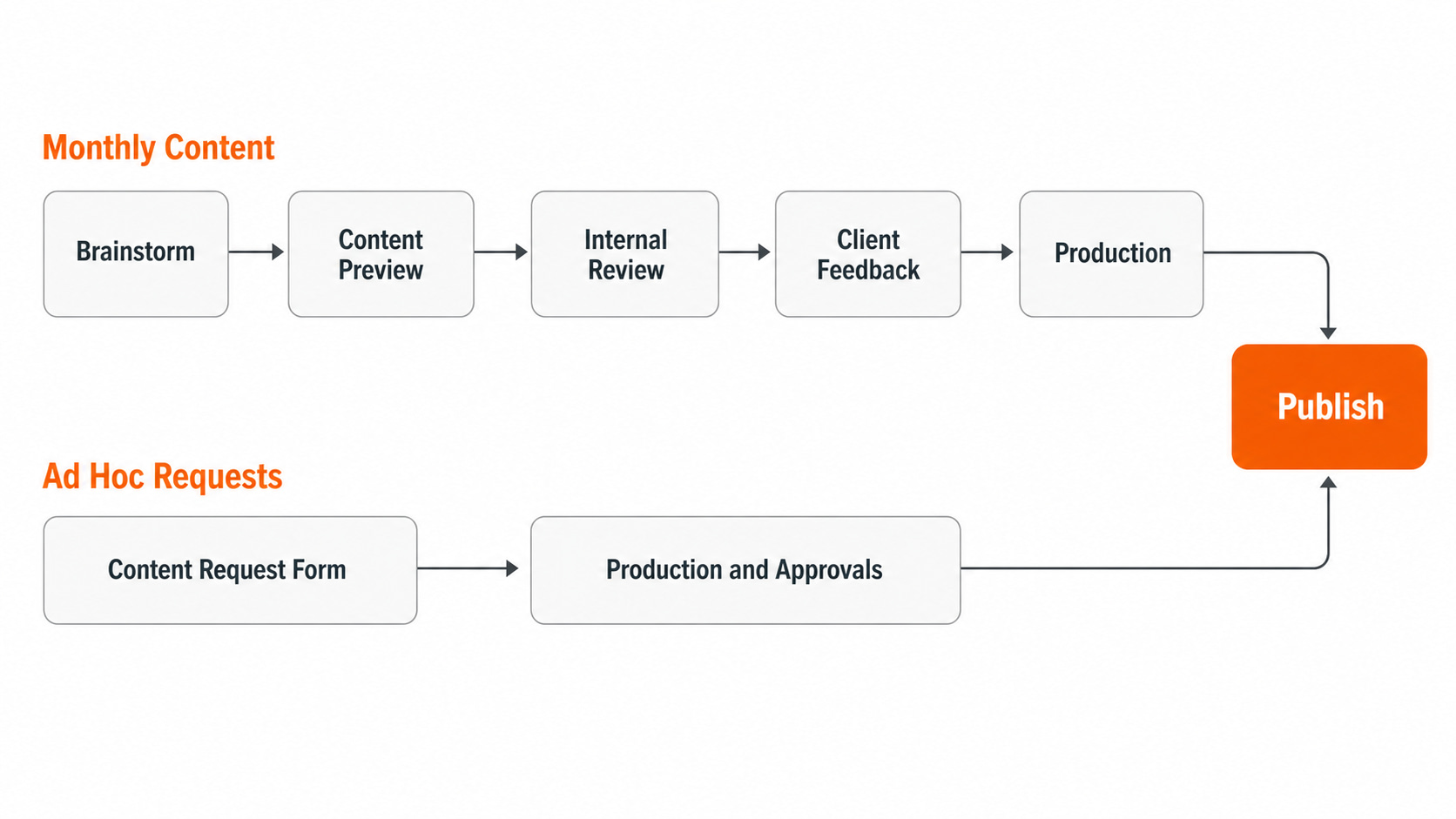
At Sculpt, our monthly content process starts 4-6 weeks before publication.
We align on key priorities, run an internal brainstorm, develop content and creative briefs, do an internal review, and then send a preview to the client for feedback.
After the approval deck is finalized and cleared internally, the client gets up to two rounds of revisions before production kicks off.
For timely or event-driven content, we use a content request form that routes directly into production with agreed SLAs based on content type.
Finally, before jumping to solutions, ask yourself this question: Are approvals a process problem?
Or is it telling you something about how social is perceived inside your organization?
That's the question worth sitting with before you set up the next automation.
Content approval workflow FAQ
A content approval workflow is the process a piece of content goes through — from first draft to published post — including every review, revision, and sign-off along the way.
Social media approval workflows typically involve internal review by the agency or marketing team, followed by client or stakeholder approval.
A well-designed workflow defines who reviews what, in what order, and by when. The goal is predictable execution and content that goes live on schedule.
As few as possible.
The most functional approval processes we've seen involve one internal reviewer and one client-side approver with the authority to give a final answer.
If more people need visibility, give them view access, not approval power. Approval by committee is where good content gets sanded down.
The workflow is the organizational structure: Who approves, in what order, within what timeframe. The tool is the interface you put on top of it.
Platforms like Planable, Sprout Social, or Gain can make a functional workflow faster and more transparent, but they can't create the workflow for you. A broken approval process in a spreadsheet is still a broken approval process in a $500/month platform.
Fix the structure first, then choose the tool that fits it.
For planned, evergreen content, 48-72 hours per review round is a reasonable benchmark.
For timely or reactive content — anything tied to a news moment, trend, or live event — that window shrinks significantly, sometimes to same-day.
The SLA should be agreed upon up front, documented, and treated as a mutual commitment: The agency delivers content that's ready for review, the client commits to responding within the window.
When both sides hold to it, the calendar runs on time.