

Catching up on social media is tough, particularly for a regulated industry like the pharmaceutical.
As if things weren’t hard enough already, there’s another big social media challenge for pharma brands.
The last time healthcare went viral, it wasn’t for the right reasons.
Lip syncs, dance trends…you know the rest of the story. People lost trust.
@priskiss #coronavirus #nurse #nursesoftiktok
♬ Oh Nanana - Bonde R300
Alas, the passing of time has been indulgent, and the industry is facing a new opportunity to do better.
Here are a few strategies and examples to make it work.
Pharma content strategies: Creativity meets compliance
Before we start, some truth: The smartest pharma brands are creative within the rules (and this is in itself a great goal).
Next, we’re listing seven strategies to keep your legal team happy and earn you attention for the right reasons.
1. Balance risk and benefit
You don’t get a free pass on risk disclosure just because you’re on X or Threads.
At the same time, that doesn’t mean you have to post walls of copy.
Our take: Get creative with formats, such as:
- Compliant captions with links to full risk profiles.
- Use visuals that support the message.
2. Highlight the human
Pharma is about people, meaning that stories from patients, researchers, and care teams usually land well.
Also, include disclosures, add context, and be transparent.
When it’s done with care, human content builds trust faster than any stat ever could.
3. Educational campaigns are your friend
Not every post needs to mention a product. Sometimes, the best move is staying unbranded.
Use your platform to raise awareness about conditions, prevention, or emerging science.
Education builds authority and also gives you space to engage without triggering compliance alarms.
4. Master misinformation response
The FDA has clear rules for correcting third-party misinformation, and there’s a right way to do it:
- Correcting third-party misinformation is voluntary/optional.
- If you do it, be truthful, non-promotional, and backed by labeling.
- Disclose who you are (whether manufacturer or rep).
- Do not link to your brand site or anything that reads like a campaign.
- Don’t cherry-pick what you correct.
And remember, you’re not on the hook for others’ actions. If your corrections get ignored, it’s not on you (but keep tabs on what you submitted!).
5. Build community
If you want long-term engagement, build and or contribute to selected spaces.
Examples include unbranded health hubs, professional forums, or patient support networks.
These are great for hosting conversations and staying compliant.
For more on this, see our guide to building B2B communities.
6. Try modular content
Pre-approved content blocks let you mix, match, and localize at scale without rerunning everything through compliance each time.
There’s information you’ll have to include; just make sure you have it adapted for different channels and ready to use when you have to (often, hopefully).
7. Work with experts (some of them are influencers too!)
You need trusted voices, and this does not equal (necessarily) types like TikTok influencers.
Partnering with healthcare professionals, researchers, or medical educators will likely result in higher engagement and conversions than someone who’s more popular but also more diluted.
Important: Make sure the roles, relationships, and compensation are clear and disclosed.
Regulatory must-knows for pharma social media
We’ve already covered how to correct third-party misinformation without breaking compliance.
But what about the stuff you're actively posting?
When pharma brands publish content—whether in their channels, through influencers, or in paid search ads—the FDA expects them to follow specific rules (even if the platform only gives you 280 characters to play with).
Below is a breakdown of what you must know to stay in bounds on social.
1. Postmarketing submissions for promotional content
If you're promoting an FDA-approved drug or biologic on social media, you must submit that content to the FDA using Form FDA 2253 for human drugs/biologics or Form FDA 2301 for animal drugs.
The content you must submit includes interactive promotional media like blogs, comment threads, social posts, and videos.
When you own, operate, or influence the platform, AND if your team, agencies, or influencers post on your behalf, you must submit the content in full at the time of first post.
In addition, you have to provide regular updates (monthly) if the content is on real-time or ongoing platforms.
If the platform is restricted-access (like a private HCP portal), you must also submit screenshots or records of the full discussion
2. Communicating risks on space-limited platforms
If you mention a product's benefits in an organic social media post, a paid ad, or a search snippet (that you control), you must also mention its most serious risks in that same post.
Here you must include:
- The brand and generic name together.
- A link to full risk info (dedicated website page).
- The risk disclosure must be prominent and readable.
What if the platform doesn’t allow fair balance?
Great question! In that case, we believe you shouldn’t promote the product there.
Consider using the channel for unbranded education, employer branding efforts, and executive social media programs, but not for pharma product promotion.
Examples of pharma brands getting it right
Let’s go through a few examples of what it means to be successfully active on socials when you’re a pharma/medical brand.
1. Gilead Sciences: Going viral on Instagram
Gilead Sciences is a pharma company dedicated to treating some of the most difficult, scary illnesses that plague the human race.
While this may sound grim, they leverage social media to show the other side of the business - the human one.
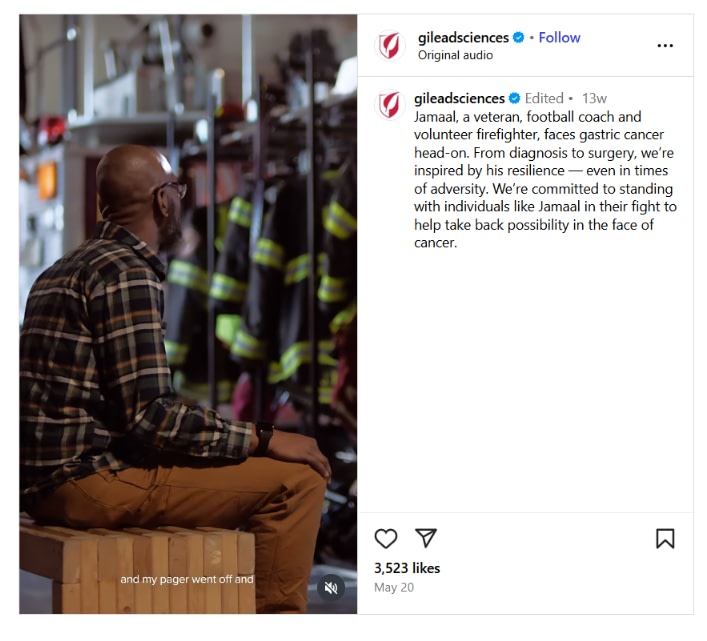
Focusing on the real protagonists is changing the company's public face, and at the same time, giving them visibility in a difficult area.
So far, their efforts are paying off, with some of their latest content going viral.
2. Roche: Clarity is the name of the game
This pharma giant needs no intro, but their social media channels do (and for good reasons).
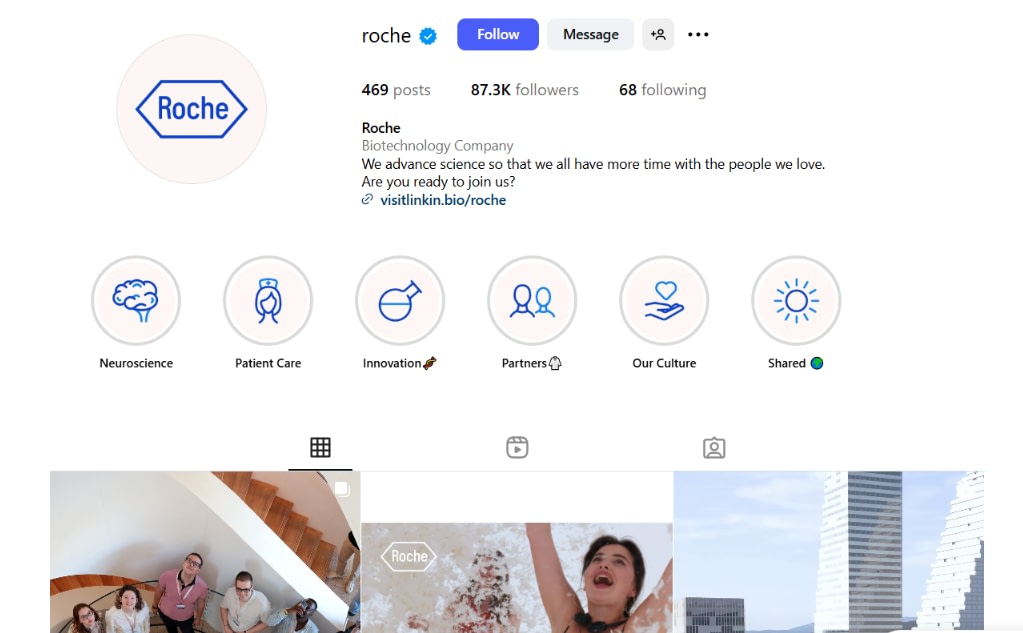
Their Instagram reflects all you want to see in an enterprise customer, including:
- The right voice and tone.
- An on-brand, carefully picked color palette.
- Straightforward messaging that doesn’t go over the top.
- Adherence (at first sight, at least) to FDA rules.
On top of this, the company has a public social media playbook to help stakeholders understand and interact with the company on social channels.
Bonus: Social media platform guidelines for pharma and health products
Each social platform plays by its own rules, and while FDA guidance comes first, you still need to play nice with platform policies.
Here’s what to look out for when reviewing platform-specific guidelines regarding healthcare, pharmaceutical, and wellness ads:
- Meta (Facebook, Instagram, Threads): Health and wellness advertising policy, and prescription drugs advertising policy.
- LinkedIn: Healthcare ads policy (includes guidelines for prescription drugs, medical devices, and other sub-categories).
- TikTok: Healthcare and pharmaceutical ads policy.
- YouTube: Full guidelines for healthcare and medicine offerings across Google’s family of products.
- Reddit: Restricted ads on the platform.
- X: Restrictions for the promotion of healthcare products, here.
Red flags: When does a pharma social strategy need help?
Some signs (but not all) are obvious.
If any of the following feel familiar, it might be time to rethink your approach:
- Only running “reminder ads”: Seasonality is real, but reminder ads are a lazy excuse for impactful campaigns.
- No plan for handling misinformation: It spreads fast and hurts your bottom line. Have a clear process for correcting it (within FDA guardrails).
- Overly sanitized posting: If no one’s reacting to your content, you’re being compliant…but no one is paying attention to you.
Pharma doesn’t need to hide behind caution tape on social media.
The key lies in turning FDA rules into frameworks for trust, education, and connection.
Disclaimer: This article represents an opinion piece only. It does not constitute legal advice. Always consult your regulatory and legal teams before making promotion decisions on social media.