

Somewhere right now, a perfectly good thought leadership idea is dying a slow death in a long approval process.
It starts as usual: with the excitement of finding something worth sharing. For instance, a founder delivering a concept that is interesting enough to make a room of strategists go quiet.
Someone writes it down and gets excited. Looks like meat’s back on the menu!
And then, due process appears, along with some obstacles. Legal flags a phrase, the CMO softens it, two stakeholders add context, context gets reworked, and so on.
What gets published 5 weeks later is yet another nothingburger congratulating the industry on how far it has come.
Yawn.
This is the part B2B thought leadership guides skip.
They describe outputs — pillars, whitepapers, posting cadences — as if ideas travel from someone's head to your feed without friction.
In real life, the interesting stuff has to survive the organization first. This article is about what survives, including:
- What thought leadership is actually made of.
- Real thought leadership examples.
We’re sorting them by what they prove, how the content gets made, and where we stand on the whole discipline.
But first, let’s find some common ground, as social-first thought leadership is far removed from what it used to be just 5 years ago.
What B2B thought leadership is (when it's social-first)
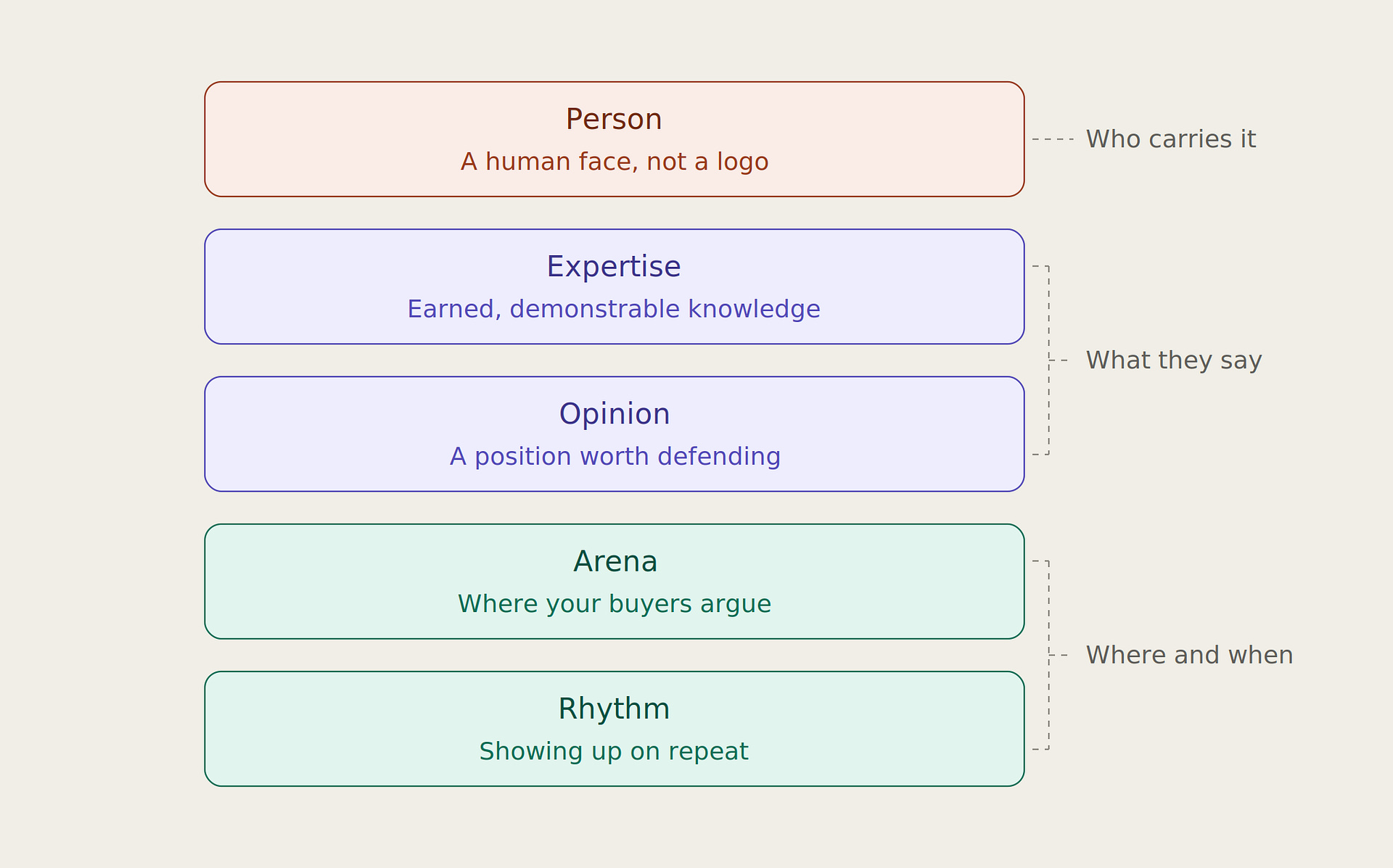
B2B thought leadership is a point of view, carried by a person that shows up consistently enough to change how buyers think about a problem — and who they trust to solve it.
Please notice what's not in that definition: formats.
Most guides define thought leadership as a list of deliverables: whitepapers, webinars, bylined articles, newsletters.
However, these are formats, deliverables.
On social media, buyers don't experience deliverables as often as they do recurring POVs, aka:
- The same person/people
- Covering a series of recurring topics
- In a recognizable manner
- Across social channels
Thought leadership lives or dies at the layer where a person commits to a position and keeps it visible.
And in B2B today, "visible" mostly means social, because it's the only surface where a POV can show up often enough, and casually enough, to start seeing results.
Nobody re-reads your whitepaper monthly, but they might as well see you weekly.
So if thought leadership is an idea layer carried by people, it has parts you can name. Which leads us to examples of thought leadership in social media.
B2B thought leadership examples, sorted by what they prove
Time to look at the feed. Below are three social media thought leadership examples, each one a different move:
- Picking a fight with a best practice
- Showing the work instead of describing it
- Choosing the right room over the biggest one
There are countless other angles to explore, but these show us how correct approaches to social thought leadership get executed.
1. Picking a fight with a best practice: Jen Zhu vs. data centers in space
In late 2025, "data centers in space" was having a moment in the AI industry. The narrative then: superior in every way, from a first-principles perspective.
Jen Zhu, cofounder and CEO of Power Dynamics, replied with a question: which principles, exactly?

Then she offered some solid reasoning in public: in a vacuum (aka, in space) there's no conduction or convection, so heat only leaves a spacecraft by radiation — slow and inefficient at operating temperatures. Cooling a 1GW load would take radiator panels kilometers wide.
The post got 330k views, 2.3k likes, 229 reposts, and 320 comments. Plenty of those comments pushed back. She replied, too.
A great example of thought leadership for two reasons:
- She produced a specific, checkable claim aimed at something everyone was repeating, and few, if anyone, questioning.
- The topic was trending, and it’s directly related to what her company offers.
2. Showing the work instead of describing it: IBM's explainer machine
IBM’s YouTube has been doing one thing, really well, for years: running serialized explainers where engineering thought leaders work through a topic on camera.
The formula includes:
- A camera-friendly technical presenter (in this case, it’s Jeff Crume — a Certified Information Systems Security Professional with a long tenure at IBM).
- A whiteboard.
- 20+ minutes of footage dissecting a trending topic.
Results so far: 300k+ views and 9.3k likes.
We conclude that most B2B brands would sign for those numbers on a 30-second cut…and if a 114-year-old enterprise like IBM can do that, a 40-person firm shouldn't really be claiming it's too risky.
3. Choosing the right room over the biggest one
In March 2026, Ramp co-founder and co-CEO Eric Glyman announced the company's launch in Europe on two channels: X and LinkedIn.
Same person, same news, copy, same image.
On X, where he has 300k+ followers, the announcement pulled 354 reactions.
On LinkedIn, where he has about 45k followers (one-seventh of his audience on X), it pulled 1,258 reactions, 57 comments, and 97 reposts.
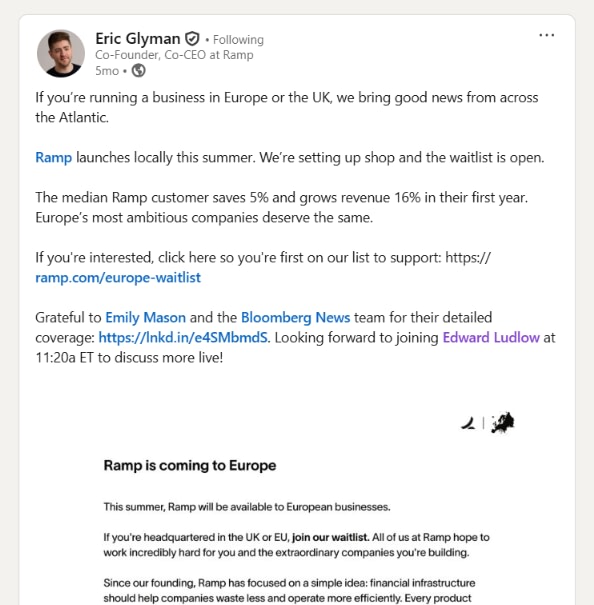
The smaller room won by 3.5x in absolute engagement.
Adjust for audience size, and it's a 20x gap.
Why does this example matter? Because an announcement is about as generic as B2B content gets. The only variable is the room.
The people who run finance at European companies live on LinkedIn, so that's where the news resonated.
Where to start with B2B thought leadership
A thought leadership operation has a lot of moving parts: extraction/sourcing, editorial calendars, exec ghostwriting workflows, distribution, measurement.
We're not covering all of that here, as none of it matters at the start. So here's step zero, done right. If you want to assess the viability of a TL program, start with the following.
1. Check your own assets and archives
Your company already holds plenty of points of view. Perhaps they’re not thoroughly organized and live in sales call recordings, Slack rants, and customer support threads, but they likely exist.
None of that was written as "thought leadership content", but don’t worry too much about that: at this stage, you’re looking for potential, not for a finished product.
Two weeks of sifting what already exists often outproduces a couple of brainstorms.
2. Interview for disagreement rather than for topics
Once the archive runs dry, you can sit down with your subject matter experts.
But instead of asking them, "What topics should we cover?" ask, “What does our industry believe that you think is wrong?”
Positions that spark pushback (and that are defensible) are the point here.
3. Clear the approval path before you write a word
Before anything gets drafted, agree on what's off-limits (legal exposure, figures, confidential information), and hand everything else to a single owner.
This will shorten reviews downstream, clearing the path ahead for your nascent thought leadership program.
4. Pick one room and one rhythm
We just watched Eric Glyman's launch post pull 3.5x the engagement in a room one-seventh the size.
Room fit beats reach, so choose the single channel with the most potential, and ignore the rest for now.
Then set a cadence you can sustain for 3-4 quarters, and show up consistently at the chosen cadence.
Where we stand on all this
Thought leadership is social-first, and that's not a preference.
Almost nobody in your market is buying right now, and those are the people thought leadership programs target: the ones who won't fill a form or take a meeting for years, then one day write a shortlist from memory.
Between now and that moment, their best chance of finding you is the feed.
Which is why we don't treat social as the distribution channel for thought leadership. The post isn't promoting the idea. The post is the idea.
Demonstrated > declared.
The good ol' “show, don’t tell”.
Jen Zhu never claimed energy expertise. She did thermal math in public and got 330k views.
Compare that with the average "proud to be recognized as an industry leader" post. Can you remember who published any of them?
The AI answer test.
Buyers now ask ChatGPT or Claude about their problem.
What comes back depends on what the model learned in training and what it finds in a live search.
Both reward the same thing: a name, tied to a position, repeated in public.
One catch, though: models don't see the feed the way we do.
Access is a patchwork. Reddit sells real-time content to Google and OpenAI, LinkedIn blocks live reading and allows partial indexing, X and Instagram keep their data for their own models.
Your post from last week might be in an AI answer already, or might not exist to it at all, depending on which platform and whose model.
Build it yourself, or build it with us
Everything we shared here works in-house. Teams pull it off all the time.
At the same time, expect to find some roadblocks ahead, specifically after:
- The archive runs dry.
- The thought leader gets busy (will happen sooner rather than later if they are C-suite).
- A post catches real pushback.
That's the job of a B2B thought leadership agency, and it's the job we do at Sculpt: strategy, positions, roadmap, production, and the discipline of showing up when your team can't.
You bring the expertise and the appetite for a point of view. We build everything around it.